

By Douglas V. Gibbs
A recent unanimous ruling by the Maine Supreme Judicial Court represents more than just a troubling custody dispute. It signals a dangerous shift in how our legal system views religious liberty in America. The decision to grant a father veto power over his daughter’s religious upbringing, effectively banning a mother from taking her child to church or reading the Bible to her, strikes at the very heart of our constitutional republic’s founding principles.
The case involves Emily Bickford and Matthew Bradeen, unmarried parents of a 13-year-old girl. After their separation, Bickford converted to Christianity and began attending Calvary Chapel Greater Portland with her daughter. When Bradeen objected to his daughter’s church involvement, he took legal action, ultimately securing sole authority over his daughter’s religious upbringing. The Maine Supreme Court upheld this decision, arguing it served the child’s “best interest” because she experienced “fear and anxiety” from church teachings about Hell and the rapture.
What makes this ruling particularly alarming is how the court treated mainstream Christian beliefs as potentially harmful. The court allowed an expert witness to describe Calvary Chapel as a “cult” and “closed social system” despite it being a mainstream evangelical denomination with well-established doctrines. The court even placed scare quotes around basic Christian teachings about Heaven, Hell, and Christ’s return, treating them as strange and dangerous ideas rather than time-honored religious beliefs.
This case is not an isolated incident but part of a growing pattern of hostility toward Christians in America. Across the country, we’re witnessing churches burning to the ground with minimal media coverage, Christian business owners being forced to violate their consciences, Faith-based organizations facing discrimination for their beliefs, and Parents being penalized for raising their children according to their religious convictions.
The media’s relative silence on church arsons, compared to their intense coverage of incidents involving other religions, demonstrates a troubling double standard. In Michigan alone, multiple churches have suffered suspicious fires, including LaGrand Avenue Christian Reformed Church where four firefighters were injured battling the blaze. Similar incidents have occurred in Ohio, Florida, Mississippi, and Idaho.
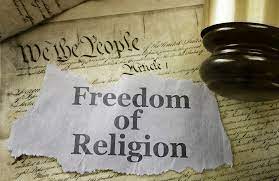
The Maine ruling directly contradicts fundamental American principles. Our Founding Fathers established religious freedom as the first right in the Bill of Rights for a reason. They understood that a society without religious liberty is not truly free. The First Amendment explicitly prohibits government interference with the free exercise of religion, and all of the state constitutions contain similar language, yet the Maine Supreme Court has effectively punished a mother for exercising this fundamental right.
The court’s reasoning that allocating religious authority to one parent doesn’t “intrude” on parental rights defies logic and precedent. By privileging the father’s non-religious perspective over the mother’s Christian faith, the court has effectively established a hierarchy of beliefs, placing secular viewpoints above religious ones.
RELATED: A NATION FORGED BY FAITH AND FREEDOM
Benjamin Franklin famously stated that “only a virtuous people are capable of freedom.” He understood that liberty requires moral restraint and that virtue, often nurtured by religious communities, is essential for self-governance. When courts begin treating basic Christian doctrines as psychological harm, they undermine the very foundation of virtue that makes liberty possible.
The Maine court’s decision reflects a dangerous shift from protecting children from actual harm to shielding them from ideas that some judges find uncomfortable. This paternalistic approach treats religious beliefs as harmful rather than formative, undermining parents’ rights to direct their children’s moral and spiritual development.
This legal discrimination exists within a broader cultural context where Christianity is increasingly portrayed as intolerant, harmful, or extreme. Our educational systems often present faith through a hostile lens, while entertainment media regularly mocks religious believers. Even simple acts of Christian charity, like a Missouri grandmother who was told she needed a commercial license to feed breakfast to community members, face government and regulatory hurdles that are in direct violation of our natural right to religious freedom.
When a coffee shop owner in Idaho kicks out customers discussing pro-life issues, or when government officials require permits for neighbors sharing breakfast, we see how hostility toward Christian values manifests in everyday life. These incidents create a chilling effect on religious expression and community involvement.
The Maine case highlights the urgent need for judicial reform and renewed commitment to religious liberty. Liberty Counsel has announced plans to appeal to the U.S. Supreme Court, arguing that the Maine decision “rejects the First Amendment right of a fit parent to raise her child consistent with her Christian faith.”
This case should concern all Americans, not just Christians. When the government can decide which religious beliefs are acceptable for parents to teach their children, everyone’s freedom is at risk. The principle at stake transcends any single custody dispute. It’s about whether the government can effectively penalize citizens for their religious convictions.
To address this crisis, we must demand that courts apply strict scrutiny to any case involving religious freedom rather than dismissing such rights as secondary to a vague “best interest” standard. We must advocate for judicial nominees who respect the Constitution’s original meaning and understand that religious liberty is not a secondary concern but a fundamental right. We must support organizations that defend religious freedom in courtrooms and legislatures. We must educate our communities about the importance of religious liberty for all Americans, not just Christians. We must elect representatives who will confirm judges who respect the First Amendment’s protection of religious exercise.
The Maine Supreme Court’s decision represents a dangerous departure from American constitutional principles. By treating mainstream Christian beliefs as harmful and restricting a parent’s right to raise her child in the faith, the court has undermined the very foundation of religious liberty that makes our constitutional republic possible.
ENJOYING THE CONTENT? DROP A FEW COINS IN THE TIP JAR…
As Benjamin Franklin understood, freedom requires virtue, and for many Americans, religious faith provides the moral foundation for that virtue. When courts begin treating time-honored religious teachings as harmful, they not only violate constitutional rights but also undermine the moral framework necessary for our constitutional republic.
The preservation of religious liberty is not just a Christian concern. It’s an American one. The Maine case should serve as a wake-up call to all who value liberty, reminding us that when any group’s constitutional rights are threatened, everyone’s freedom is diminished. The path forward requires renewed commitment to the principles that has made America exceptional, including robust protection for religious liberty as the cornerstone of all our natural God-given rights.
— Political Pistachio Conservative News and Commentary