

By Douglas V. Gibbs
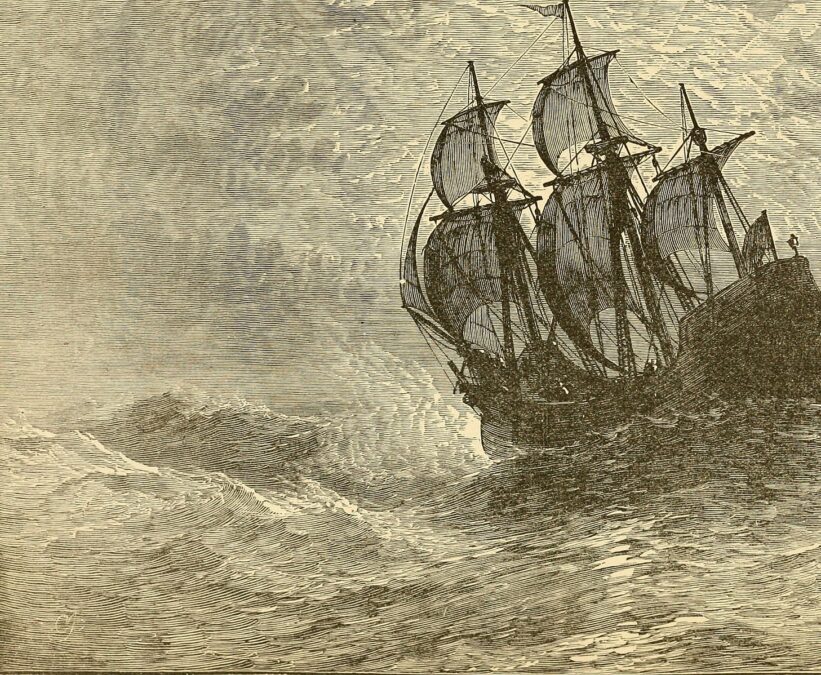
Below the “Voyage Timeline” is my rendition of what a diary entry might have looked like by one of the passengers on the Mayflower as it crossed the Atlantic Ocean on its way to the New World. They departed September 16, 1620, and it took just under ten weeks to reach their destination.
Voyage Timeline
- August 15, 1620: Initially left Southampton, England, alongside a smaller ship named the Speedwell.
- August-September 1620: The Speedwell leaked and forced them to return to port twice (first to Dartmouth, then Plymouth).
- September 16, 1620: Left Plymouth alone after abandoning the unseaworthy Speedwell and taking on remaining passengers.
- November 21, 1620: Made landfall near Cape Cod, Massachusetts, after a 66-day journey
The first light filtering through the cracks in the deck above brings no comfort. Another day of this wooden prison. Fifty-seven days since we last saw the English coast, though the ship’s master claims it’s been fifty-five. The counting has become my only ritual in this endless rocking world. Due to the delays by the failure of the Speedwell, we are more cramped than ought to be, and sail during the height of the Atlantic autumn storm season.
The space between decks is my world now. The fierce storms have forced the crew to lock down the overhead hatches. The space is no taller than a man can stand, and many cannot stand fully. The cramped hold is filled with the tangled limbs of more than a hundred souls. Due to the closed hatches, while the massive waves are kept out, the foul smelling space is completely dark. The wooden seams are leaking. We sleep where we fall in the wet and cold, curled around our meager belongings that are also moist from the conditions. The foul air is thick with the smell of unwashed bodies, stale breath, and the ever-present stench of the bilge below. Someone coughed near me at one point. Vomiting has been widespread, as most of the passengers have been sick from the pitching ocean. We live listening to a deep, wet rattle that has become the common chorus of our nights.
Above, I hear the sailors’ boots on deck, their calls to each other in words I’ve learned but don’t understand. There’s about thirty of them, I believe. They move with purpose while we passengers drift like lost cargo. The constant creak of timber, the slap of waves against hull, the groaning of masts. These are the voices of our confinement now.
For breakfast, a portion of hardtack so old it was baked before we left England. There is no hot cooking allowed, with the ship tossing in the storms. Sometimes we receive salted pork or beef, dried peas, or oatmeal – all cold. I dipped my hardtack in my water ration to soften it, though the water itself tastes foul. The wooden barrels has turned the water slimy and green. Most of the people, including children, drink weak beer instead of the water to quench their thirst. We’re down to half rations again. The ship’s master announced yesterday that our provisions are running low. Some men whisper we should have turned back weeks ago, but there’s no turning back now.
Midday brings a brief respite when they allow us on deck in small groups. The sun feels distant, its warmth barely penetrating the damp chill that seems to emanate from the very planks of this ship. The ocean stretches endlessly in all directions, its surface heaving like some great breathing creature. I watch the sailors work the rigging with practiced ease, their movements economical and sure. They seem to belong to this world of wind and water, while I remain an intruder.
Two of our company are feverish now, their faces flushed, their breathing shallow. The ship’s surgeon bled one yesterday, making him weaker still. One woman is with child. She’s the loudest of all, sometimes, screaming that the birth may come at anytime. There’s talk of the scurvy, but we know little of these journeys or exactly what that means – only that it comes with long voyages and claims lives.
The latrine buckets overflow daily, their contents sloshing across the deck when the ship pitches violently. We’ve learned to step carefully, but still the filth spreads. Some have taken to relieving themselves over the side when allowed on deck, despite the danger of being washed away by a sudden wave.
When night falls and we return to our cramped spaces, the ship groans as if in pain with each wave that strikes her side. I close my eyes and try to remember the feel of solid earth beneath my feet, the smell of rain on soil, the taste of fresh food. These memories grow fainter with each passing day.
Tomorrow will be the same. And the day after. Until we reach this new world or this wooden coffin becomes our grave. The uncertainty is worse than the hardship. I pray for landfall.
— Political Pistachio Conservative News and Commentary