

By Douglas V. Gibbs
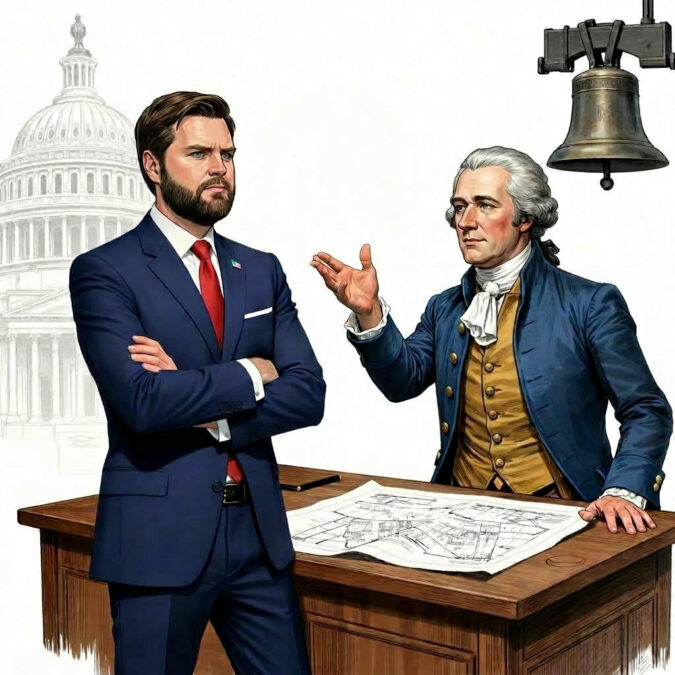
Vice President J.D. Vance made a recent statement that “American economic policy on the right is now much more Alexander Hamilton than it is Milton Friedman. I think that’s obviously a good thing.” He went on to say, “If you look at modern Britain and the result of Margaret Thatcher’s policies, you would say that her policies actually got Britain further away from that ideal and not closer to that ideal.” The comment represents a significant departure from traditional conservative economic thought, and for me is very concerning.
As a constitutional originalist, I value constitutional principles and free-market economics. Therefore, I have always been someone who is not a fan of Alexander Hamilton. He was a patriot who fought during the Revolutionary War and was a trusted scribe of General George Washington’s, and he was among the primary spark-plugs that set in motion the Constitutional Convention in Philadelphia in 1787. He was so trusted by Washington that when the famed general became the first President of the United States under the new federal government created by the U.S. Constitution, when Robert Morris turned down Treasury Secretary and suggested the office be given to Hamilton, Washington was happy to oblige. But, Hamilton’s ideas regarding how much power should be possessed by the federal government, and his ideas about economics were not in line with the basic tenants of the Constitution, and not in line with what we consider today to be sound economic ideas – at least from a truly free market standpoint.
Hamilton’s approach to economics centered on a strong central bank, federal assumption of state debts, protective tariffs that mirrored the British practice of mercantilism, and government intervention in economic development (centralized planning). These positions stand in stark contrast to Jeffersonian principles of limited government and free-market capitalism that have traditionally been cornerstones of conservative thought. Hamilton’s advocacy for a national bank and implied powers created constitutional precedents that expanded federal authority beyond what the framers of the Constitution intended.
Vance’s criticism of Friedman and Thatcher is particularly concerning from a free-market perspective. His dismissal of meritocracy and suggestion that economic prosperity should not be prioritized suggests a shift toward a more communitarian or even nationalist economic framework rather than the individualistic, liberty-focused approach that has defined modern conservatism and the concept of a truly free market.
I am not completely appalled by everything he said according to the Hot Air article referenced early on in this article. His statement also frames tariffs as now being the “baseline position” in the GOP, and he said that reflects how much the party has moved away from its free-trade roots. While this represents a fundamental philosophical shift away from previous conservative GOP positions, originalists and classical liberals would refer back to Thomas Jefferson’s presidency where protective tariffs that hinged on mercantilism were abandoned, tariffs were still used as a tool to ensure fair trade, rather than a truly free trade environment. Free trade fails when the playing field is tilted against you.
Before I completely write-off Vance, I realize I need to consider that he is likely positioning himself for the 2028 primary by appealing to the populist wing of the voting public. Until I cam across these statements about Hamilton the clues regarding his potential actual governance style may very-well differ from his rhetorical positioning. There may be strategic elements to these statements that aren’t immediately apparent. That said, I believe my concerns to be valid. If Vance genuinely embraces Hamiltonian economics over Friedmanite free-market principles, he would indeed represent a departure from the conservative tradition that values limited government and economic freedom.
— Political Pistachio Conservative News and Commentary