
By Douglas V. Gibbs
In the battle of Left versus Right, it is important to understand what it all means in the first place. Likeminded individuals naturally tend to gather together when a theater of opinion erupts. Congregating in such a manner, creating political parties, is a part of our human nature. Houses, or chambers, of government are no different. Members of the political assembly who support similar agendas sit together, much in the way social allies tend to hang out together at a dinner party. The classification of “left” and “right” grew out of the tendency of people to group together on one side, or the other.
The early definition of “left” and “right” was different than in today’s American Society. Among the most commonly known split between the left and the right in a political assembly occurred in France before the French Revolution. Members of the National Assembly sat on the right or the left of the hall depending on their level of political support in regards to the ruling monarchy.
Those in support of the monarchy, and the religious elements that came with the reigning government, would sit on the right. The people on the right were defined as being those holding traditional interests in line with the Church and the monarchy, believing the king ruled by divine right, and that Catholicism must continue to be the state religion, and therefore continue to be a strong influence on governance. The people who sat on the right side of the assembly believed that the Church had a vested interest in the political system, and they sought to preserve that system.
Those who sat on the left side of the hall in France during the period preceding the French Revolution did so in support of “enlightenment,” which was considered to be in the interests of rationalism and secularism. The left used secular elements to challenge the Church’s long-held influence over government, fostering nationalism among its allies, and promoting hope in constructing and shaping the political community. The left desired to change government by overthrowing the Church and the aristocracy by promoting secularism and nationalism. The planners of this glorious new “enlightened” government became the leaders of France after the French Revolution, orchestrating a Reign of Terror, which was a period of chaos during which thousands were guillotined for being politically incorrect.
The radicals within this new government saw the Catholic Church as the enemy while promoting its Cult of Reason. Like with the monarchy before them, however, it became clear that to control the political and social upheaval, the government in place must also become tyrannical in their own right. Under the rule of statism, France remained a nation unable to cultivate liberty, and one that remained under the iron fist of a dictatorial government. For many, this was no surprise. Some of the planners of the change of the form of government in France knew that in order to keep order they would need to “treat the people as cattle.”
The French National Assembly established a constitutional monarchy and adopted a new constitution in 1791 that created a Legislative Assembly. The political assembly, as with any other political body, rapidly divided into factions opposing each other. The three factions that formed in the new French Legislative Assembly were the radicals (liberals), moderates (centrists) and conservatives. The radicals (liberals) sat in the left section of the assembly hall, the conservatives sat on the right, and the moderates sat in the center section. Their political identities have some similarities to political movements today in the United States, but had little in common with the pre-revolution arrangement that emphasized itself more on monarchy and religion.
America is much younger than the European nations, and never had a landlord class of titled nobles. In fact, the Constitution specifically prohibits such a system. The Founding Fathers desired to break away from European traditions as much as possible, even abandoning much of British Common Law when defining citizenship. To be a British Subject the rules were weak, and divided loyalties ran rampant throughout the British Empire. The United States as a Union could not tolerate divided loyalties, and placed a stronger standard of natural born citizenship upon the President in order to eliminate the opportunity for the executor of the American Form of Government to harbor divided loyalties between the United States of America, and any other nation. That way, the new American government could break completely free of any European influence, and forge itself into a Republic independent from British influence, and in fact, the authoritarian nature of Europe as a whole. The political landscape of the United States of America, since there never was a class of nobles, was simple in the young country. Either you were a Federalist, an anti-Federalist, or somewhere in between (Nationalists did grow out of the movement, and then deceptively named their political party the Federalist Party).
Those who sought a stronger centralized federal government were followers of Alexander Hamilton. They stood in opposition of those who believed that the federal role in government should be limited greatly. There were others who found themselves somewhere between the two political beliefs.
Unlike the Europeans, royalty and religion played no role in determining the nature of American political philosophies. Nearly all of the early American Politicians were deeply religious men, but the political spectrum did not separate factions along religious lines. God played a major role in the principle foundation of America, but the founding fathers also determined that no religion could ever take an official role in government; hence, the Establishment Clause in the First Amendment. The establishment of any religion as the official religion of the United States was forbidden. That said, Congress was also forbidden to make any law that infringed upon the freedom of an individual to practice their religion. Almost all of the signers of the Declaration of Independence were either clergy, or highly involved in their church. 27 of the 56 signers had Christian seminary degrees. The Founding Fathers fervently prayed in Congress.
Benjamin Franklin is widely regarded to be among the least religious of the Founding Fathers. However, his speech given to Congress on June 28, 1787 asking that Congress have a prayer every morning before conducting business was overtly religious in nature. Despite modern assumptions, there was not a political battle between The Church and the secularists during the founding of the United States of America. The battle was between the percentage of power of the government in the lives of the people.
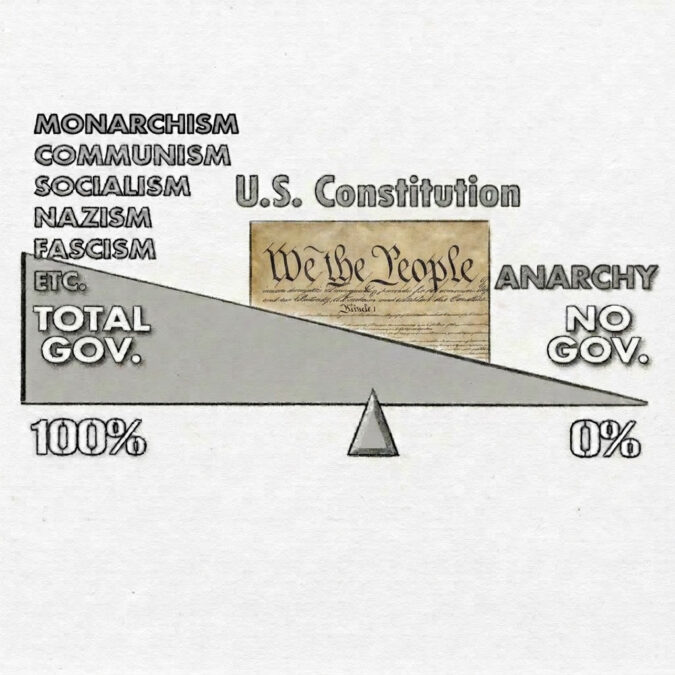
America’s political spectrum evolved differently than the one in France., The American political spectrum became more about the level of control of government over a society, rather than the presence of a monarchy, or established church. From the American point of view, zero percent of government intrusion on the lives of the people inhabits the far right of the current political spectrum, which is a condition known as anarchy. 100% governmental control inhabits the far left extremity of the Political Spectrum (a totalitarian government). The American form of government, or a Constitutional Republic that operates under the rule of law, is at the center of the political spectrum.
Most of the current forms of government present in today’s international political arena reside on the left side of the Political Spectrum, drawing their foundations from socialist principles. Socialism is inherently authoritarian. Socialism, like the radicals from the French Revolution, claims to seek to overthrow the Church and aristocracy by promoting atheism and nationalism, only replacing the government they thought to be a tyranny with a tyranny of their own. In Russia, the rise of socialism held the basic tenet of replacing the individual’s commitment to God with a commitment to love and serve a collective society ruled by an elite few.
When one examines the communist society, which resides on the left side of the Political Spectrum, one finds that if society was ruled over by an equally powerful religious theocracy, the basic governmental elements of the ruling doctrine are the same, and just as tyrannical. Therefore, a controlling government based on religion is no different than an atheistic system of communism. Either way, the form of governance is based on a centralized control over the people, and limits on personal individualism and freedoms.
Economically, leftism encourages increased government involvement with the instruments that regulate the economy. Under a leftist economic system, such as in the communist model, the government seizes control of the industries, eliminating private ownership (control over the means of production). In the fascist model, the authoritarian political entity engages in corporatism, allowing the private enterprises to remain private, yet bundled together in a uniting strength under authoritarian government regulatory rule. Because fascism (from Italian fascismo, Benito Mussolini’s authoritarian political movement in Italy 1922 to 1943) was created to be an adverse reaction to the apparent economic failure of Marxism, and labeled itself as the opposite of communism, fascism is often referred to as being right-wing, and ultra-conservative. If you break down the political structure of fascism, however, it becomes apparent that defining fascism as being on the right side of the political spectrum is dishonest. Like socialism, fascism exalts the group above the individual (in fascist states sometimes the nation or race is exalted above the identity of the individual). Like other leftist systems, fascism also calls for a complete separation of church and state, a national civilian army, and progressive taxation. And, in fascism, as in communism, the state controls the means of production, but through heavy regulation, rather than owning the means of production.
Though fascism, during the early twentieth century, claimed to be anti-communist, the authoritarian National Socialism aspect of the ideology places fascism on the left side of the Political Spectrum.
From a modern point of view, the true definition of the Political Spectrum is dependent upon how government interacts with society. Increased government intrusion moves needle on the spectrum to the left. Increasing limitations on government intrusion moves the needle to the right. In both cases, the extreme of totalitarianism, or anarchy, are equally dangerous. Ultimately, most forms of government, despite the promise of fairness, are often only precursors to another form of government. The Founding Fathers realized this, recognizing that the only form of government that both limits the powers of the federal government, while still giving it adequate authority to secure and preserve Natural Rights, is a Constitutional Republic. They knew that if you pursue leftism too far, an authoritarian government would rise from the movement. If government was limited too much, and the government did not have enough power to enforce law, an authoritarian government would also rise to fill the void.
— Political Pistachio Conservative News and Commentary