
By Douglas V. Gibbs
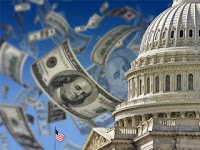
The United States National Debt topped $40 trillion for the first time in history on August 18, 2026. The number has been roughly rising a trillion dollars about every five months over the last couple years. When the news of the $40 trillion milestone hit the wire, the lefties in my life began to grumble about how Trump and the Republicans have been driving the national debt up faster than ever before with their “senseless wars” and their “federal spending on the ballroom” and “Trump’s self-aggrandizing spending” to “help his billionaire friends.” None of their accusations are true.
The White House Ballroom is being paid for by private donors. The UFC fight was paid for by Ultimate Fighting Championship (UFC) and its affiliated groups. The Grand Prix race was paid for by Penske. The America 250 Anniversary events and fireworks were largely paid for by corporate sponsorships, though some of it was funded by federal taxpayer money appropriated by Congress – the federal spending largely was for the staging, fireworks, and security. Roughly $25 million came from private funding by over 80 major corporate entities.
DOGE was created by President Trump to reduce federal spending by exposing and eliminating wasteful, corrupt, and fraudulent spending. $2.7 trillion alone has been identified regarding payments since 2003 that were made in error, in the wrong amount, or without proper documentation. The General Services Administration announced it has identified suspected fraud by federal contractors totally in $13 billion since March this year, a realization that is primary due to the work by Vice President J.D. Vance as “fraud czar.” President Trump has made rooting out wasteful and fraudulent spending, as well as deregulation, a core priority. He has slowed the growth of federal rules more than we’ve seen over the last one hundred years (aside from President Reagan, with Trump matching and often exceeding President Ronald Reagan’s benchmark for active deregulation along the way) – all of which reduces the outflow of federal funds – and all of which the Democratic Party screamed bloody murder over.
Yes, the national debt is still skyrocketing, but not because of President Trump’s policies.
The growth of the national debt, in addition to unconstitutional federal spending, is primarily due to interest costs – and when you have a larger burden you get higher interest costs which then makes it a vicious cycle that continues to feed the voracious beast more and more.
Over the next decade, according to the Congressional Budget Office (CBO) the national debt will exceed $60 trillion if nothing stops its growth. And, the problem is, despite measures seeking to do otherwise, debt harms economic growth, slows natural wage increases, and increases the cost of living and the cost of doing business.
So, if Presidents Reagan and Trump spent so much time trying to get a handle on federal spending (while accusations about military spending and other spending gets launched against those two presidents), why is it we can’t seem to slow down the rise of the national debt?
Two key problems: Unconstitutional spending, and the Federal Reserve – both of which exist due to leftist policies by both Democrats and Republicans during our last couple centuries of existence.
The First Treasury Secretary Alexander Hamilton, our first big-government lefty in American History that slammed the hammer of debt into place, argued that a perpetual national debt was good for the country – claiming it creates credit and makes it less likely that states would secede. He argued for the Bank of the United States, and got his way in 1791, using the unconstitutional concept of implied powers to convince Congress to pass the bill. Secretary of State Thomas Jefferson was staunchly opposed to the idea of a centralized national bank that took the money-creation task out of the hands of Congress. The only upside is that the charter for the bank would only be good for twenty years, and then expire unless renewed by Congress.
A $75 million debt launched America after Treasury Secretary Alexander Hamilton consolidated state and federal debts from the American Revolutionary War.
During Jefferson’s presidency many years later, he reduced the national debt seven of the eight years he was in the White House – the only year the national debt went up was during his military execution of the First Barbary War. He inherited a debt of over $83 million, and had it down to about $57 million by the end of his presidency.
James Madison initially strictly opposed a central bank, and under his watch the First Bank of the United States’ charter expired in 1811. However, during the chaos of the War of 1812, the federal government struggled to secure lines of credit or major loans to fund the war. Proponents of a central bank argued that if a central bank had been in place, hundreds of local state banks would not have needed to print their own unregulated paper money. Inflation peaked in 1814, and local banks began to refuse to exchange paper notes for actual gold or silver, pushing the country to the verge of an economic collapse. Treasury Secretary Alexander Dallas pushed Madison to change his tune regarding a central bank, and though Madison vetoed early proposals for a new bank between 1814 and 1815, he cast aside his constitutional objections in 1816 and signed the act establishing the Second Bank of the United States with a 20-year charter. While during his first term, the national debt actually ticked downward from $57 million to $45 Million, the War of 1812 pushed the debt to nearly a hundred million dollars. Once the Second Bank of the United States went into action, the debt ballooned to well over $123 million by the end of Madison’s presidency after 1817.
Presidents James Monroe and John Quincy Adams worked aggressively with highly efficient budgets to reduce the national debt, lowering the debt to below $50 million by the time President Andrew Jackson took office.
Under Andrew Jackson, on January 1, 1835, the U.S. National Debt officially reached $0, but by the end of the year new public borrowing and economic shifts pushed the country back into debt. Unfortunately, while President Andrew Jackson did largely cut federal spending and kept federal expenditures low and aggressively vetoed internal improvement bills (which he correctly believed were expenditures that belonged to the states), the mechanisms that truly erased the debt were high import tariffs and federal land sales. The dismantling of the Second Bank of the United States did not directly assist in paying down the national debt, but it did slow down the increase of public debt. The movement of federal money into local state banks created a separate problem, fueling a credit boom that would lead to the Panic of 1837. During the period between the end of the Second Bank of the United States and the rise of the Federal Reserve, the American economy saw the elimination of unnatural economic distortions, but the Panic of 1907 is noted by some economists as being the motivation for Congress to establish the Federal Reserve.
The National Debt during the period following the Panic of 1837 remained relatively low, with a gradual rise of about $3.3 million for the next twenty-or-so years. In 1860 the debt jumped to $65 million, blamed largely on funding geographic expansion and anticipatory build-up on the eve of the War Between the States. During the “American Civil War” the debt exploded, peaking at $2.7 billion in 1865. By the mid 1890s, the national debt was brought down to about $1.8 billion. Unfortunately, the Spanish-American War in 1898 bumped it back upward, again, with the number topping $2 billion at the turn of the century.
The National Debt did not reach $3 billion until 1916, jumped to over $5 billion in 1917, and the by the end of World War I sat at nearly $26 billion. During the Roaring Twenties, largely under the tutelage of President Calvin Coolidge, the number was down to roughly $17 billion before the Market Crash in 1929.
The National Debt gradually climbed during the Great Depression, and then when defense spending skyrocketed due to World War II, so did the debt – with the debt reaching well over $250 billion by the end of the war. Our debt went up and down during the dawn of the Cold War, the approach of the Korean War and a couple years of recession in 1948 and 1949. It was $255 billion in 1951. Then it climbed to $274 billion by 1955, and then the number dropped to $273 billion in 1956 and $271 billion in 1957… and that was the last time our debt amount went downward.
The National Debt reached $300 billion in 1963, $400 billion in 1972, $500 billion in 1975, and $1 trillion in 1982. In 2008 it hit $10 trillion. $20 trillion in 2017. $30 trillion in 2022. And now, we’re over $40 trillion.
The reality is that the National Debt, as much as some might wish to blame particular presidents as the cause, is not the work of one president, or one political party. In fact, the combination of unconstitutional spending and the Federal Reserve (our modern day central bank) acting as the facilitator of our debt, has been the foundational engine enabling endless government debt and structural deficits. The system creates fiat currency, especially now with the digital option, suppresses interest rates, and provides an endless backstop by acting as a last-resort buyer that essentially removes any natural market discipline that would normally punish reckless borrowing and unconstitutional spending.
And, despite all of President Trump’s attempts to slow down the debt, put a stopper in wasteful spending, and deregulate, as long as the Federal Reserve remains in place, and unconstitutional spending continues at break-neck speed, the National Debt will not only continue to rise, but the speed will continue to increase. By 2036 we will likely be over $60 trillion.
— Political Pistachio Conservative News and Commentary