

By Douglas V. Gibbs
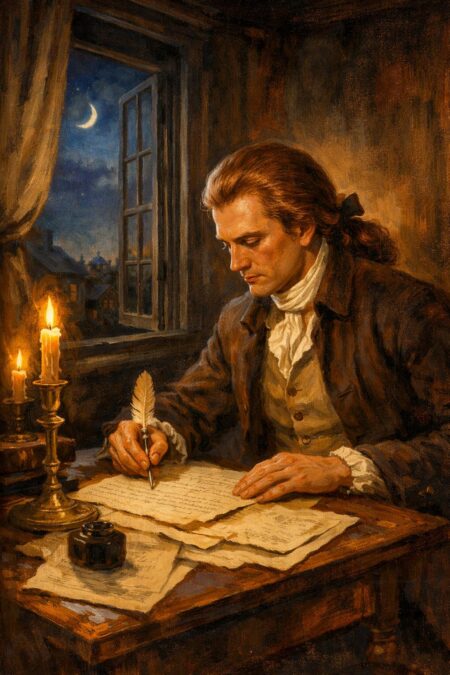
The complexities of Thomas Jefferson have long fascinated historians and constitutional scholars alike. For decades, we’ve been presented with a narrative of contradictions. He was the man who penned “all men are created equal” while enslaving hundreds of human beings. Yet perhaps these apparent contradictions are not paradoxes at all, but rather the natural tensions of a man navigating the complexities of his time with the limited tools available to him. To truly understand Jefferson, we must remove our 2026 hats and don the eighteenth-century perspective he inhabited.
When Jefferson wrote about equality in the Declaration of Independence, he was not espousing the modern concept of equal outcomes. Rather, he articulated a theological principle: that all humans are created equal in God’s eyes, equally endowed with natural rights by their Creator. This equality of divine origin does not imply uniformity of ability or circumstance. Jefferson recognized that humans possess different strengths, weaknesses, experiences, and circumstances; differences that are not only natural but beneficial to society as a whole.
The modern collectivist vision of equality focuses on equalizing outcomes at the finish line, but Jefferson’s conception celebrated the journey itself – the individual pursuit of happiness within one’s circumstances, taking responsibility for one’s decisions, and learning from both triumphs and failures. This is the essence of liberty: that our destination is a direct result of our choices, good or bad, despite the influences and luck that shape our paths.
Jefferson’s life was marked by significant personal challenges that history often glosses over. While considered part of elite society, he was perpetually land-rich and cash-poor, struggling to maintain the image required of his status. He experienced profound personal tragedies during the Revolutionary period, losing his mother, sister, and wife Martha to illness while shouldering the weight of revolutionary responsibilities.
These losses occurred while he was authoring the Declaration of Independence and serving as a diplomat – roles that demanded his full attention. Yet Jefferson, ever the pragmatist, dealt with these tragedies as needed emotionally and then “soldiered forward” to fulfill his public duties. This ability to compartmentalize personal pain while pursuing public service speaks to his remarkable character.
RELATED: JEFFERSON’S LIBERTY, CICERO’S FULFILLMENT
A crucial turning point in Jefferson’s life came in 1773, just over a year into his marriage to Martha, when he inherited approximately 100 slaves and substantial debt from his father-in-law John Wayles. This inheritance created an impossible situation: Jefferson, who already opposed slavery on principle, now found himself legally responsible for more human beings while simultaneously inheriting the financial obligations that made emancipation virtually impossible.
Virginia’s laws at the time made manumission extraordinarily difficult, requiring provisions for the freed slaves that Jefferson simply could not afford. He was trapped by circumstance. He was morally opposed to slavery, yet legally and financially bound to maintain it. This is not contradiction as advertised by modern critics, but the reality of Jefferson’s life. It was simply the kind of difficult situation people face when ideals collide with practical limitations.
The relationship between Jefferson and Sally Hemings has long been the subject of historical debate and moral judgment. Yet here too, context matters. Sally was Martha’s half-sister. She was the daughter of John Wayles and his slave Elizabeth “Betty” Hemings. By all accounts, she resembled Martha, with light skin and straight hair.
When Jefferson took Sally to France as a teenager, she could have claimed her freedom under French law but chose to return to Virginia with him, reportedly after negotiating freedom for her future children. This detail alone suggests a relationship more complex than simple exploitation.
A recent DNA study seems to confirm Jefferson as the father of Hemings’ children, but it doesn’t necessarily reveal the scandal many assume. Rather, it likely reflects a relationship born of proximity, shared grief (Sally resembling his beloved Martha), and the complicated dynamics of eighteenth-century life, where boundaries between master and slave were sometimes blurred by genuine human connection.
Evidence suggests Jefferson maintained relatively good relationships with his enslaved workers. When he returned from France, a group reportedly carried him up the hill to Monticello on their shoulders. Upon his death, one slave remained by his side until his final breath; actions difficult to explain if Jefferson were universally despised.
This doesn’t excuse slavery or minimize its horrors, but it does challenge simplistic narratives of pure oppression. Jefferson seems to have viewed his enslaved workers as something between family and employees. People for whom he was responsible, even while recognizing the moral wrongness of their legal status.
Jefferson consistently advocated for gradual emancipation rather than immediate abolition. He believed that people who had only known slavery would struggle to navigate freedom successfully. I suppose one might compare the situation to animals raised in captivity who cannot survive in the wild without learning necessary skills.
RELATED: HAMILTON VS. JEFFERSON
This position, while paternalistic by modern standards, reflected his pragmatic approach to social change. He wanted desperately for slavery to end but believed it must happen through a process that prepared both enslaved people and society for the transition. Though he hoped to see this accomplished in his lifetime, circumstances prevented it.
The modern tendency to view history through an oppressor/oppressed lens prevents genuine understanding. When I once explained to three young black women that most Founding Fathers actually believed in the eventual abolition of slavery, one called me “ignorant” and threw my materials back at me. This reaction illustrates how the collectivist mindset has replaced critical thinking with moral certainty.
Frederick Douglass himself evolved from viewing the Constitution as pro-slavery to recognizing its anti-slavery principles. This transformation demonstrates the importance of approaching history with openness rather than certainty, with questions rather than answers.
Thomas Jefferson was neither saint nor villain but a human being navigating extraordinary circumstances with the limited tools available to him. He was a brilliant thinker who articulated principles that transcended his time while practicing behaviors that reflected its limitations.
Understanding Jefferson requires us to embrace context rather than judgment, and complexity rather than simplicity. It requires us to recognize that two things can be true simultaneously: Jefferson was a slaveowner who hated slavery, a man who believed in equality while practicing inequality. These aren’t contradictions but realities – the kind of tensions all humans face when ideals collide with circumstances.
In the end, Jefferson’s story is not about paradox but about humanity: flawed, fallible, yet striving toward ideals that exceeded his grasp. His legacy teaches us that understanding requires context, that judgment requires humility, and that history’s greatest lessons often lie not in the moral certainties we impose upon the past, but in the nuanced realities we discover when we dare to look beyond the surface.
— Political Pistachio Conservative News and Commentary