
By Douglas V. Gibbs
This year we celebrated 250 years of freedom. In 1776, thirteen plucky English Colonies along the Atlantic Coast declared independence by signing the Declaration of Independence, and became the thirteen original states of the United States of America… well… sort of.
Delaware was never technically a separate colony. The territory was the “The Lower Counties on Delaware.” Pennsylvania wanted direct ocean access, so William Penn in 1682 acquired Delaware Bay and access to the Delaware River from the Duke of York. The title to the Lower Counties came from a different source than his 1681 royal charter for Pennsylvania.
Pennsylvania and Delaware both belonged to the Province of Pennsylvania, but did not come from the same legal instrument. While on paper Delaware was a part of Pennsylvania, the lower counties (or the “Territories of Pennsylvania”) of New Castle, Kent, and Sussex never felt that way.
The residents of the lower counties frequently clashed with the upper parts of Pennsylvania, so in 1701 Penn offered them an opportunity to form their own assembly, known as the Charter of Privileges. Delaware accepted that option in 1704. Under the new assembly, Delaware possessed its own courts and its own laws, but still remained under the same governor with Pennsylvania – as well as under the same proprietor: The Penn family. So, for many years Delaware belonged to Pennsylvania. It was not technically a colony, nor technically official Pennsylvania counties. The region was, in a sense, in legal limbo. So, on paper, before we had the Thirteen Original States, we had Twelve Original Colonies. When Delaware declared independence, the fourth state to do so, they were not only declaring independence from Britain, but also from Pennsylvania.
By the 1770s, Delaware was for all sentiments a colony. They had their own assembly since 1704, and they sent their own delegates to the Continental Congress to discuss independence; Caesar Rodney, Thomas McKean, and George Read. In 1774, on the Articles of Association (or the Continental Association) the delegates who were signatories for Delaware were listed separately from Pennsylvania, but were labeled as representing “Pennsylvania, the Three Lower Counties of New Castle, Kent and Sussex, on Delaware.”
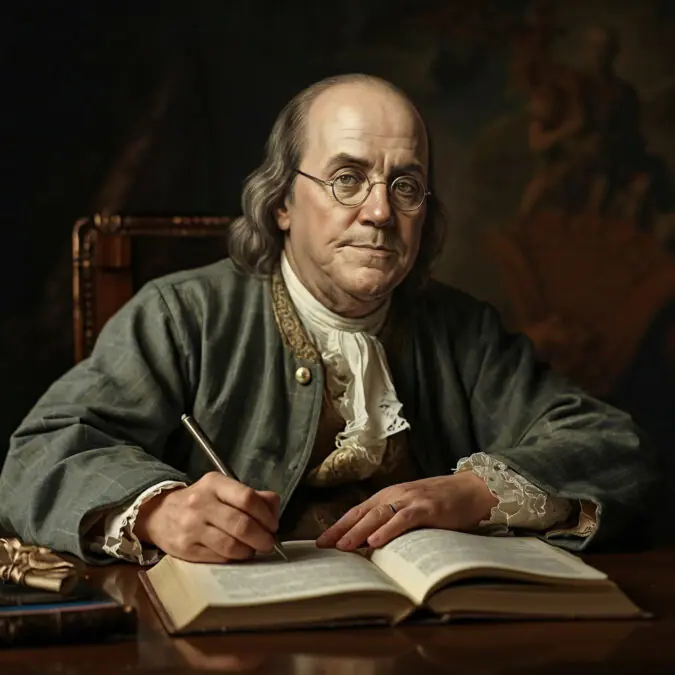
In 1754, the Albany Plan omitted Delaware entirely, folding it into Pennsylvania’s seat. In August 1753, Benjamin Franklin had been appointed Postmaster General of North America. He personally ran the only institution that physically linked all of the colonies. He was also the man who drew a political cartoon of a snake severed into eight writhing segments, arranged left to right along a single line. Each segment was labeled with a colonial abbreviation. S.C., N.C., V., M., P., N.J., N.Y., N.E. – the last representing New England: Massachusetts, New Hampshire, Connecticut, and Rhode Island. The region was popularly known at the time as New England, though they were not technically under any active formal union or technical agreement. That said, twice the region had been bound under formal, legal agreements. The United Colonies of New England (1643-1684), which was also known as the New England Confederation, strictly excluded Rhode Island and New Hampshire. The original New England alliance was between four strictly Puritan colonies: Massachusetts Bay, Plymouth, Connecticut, and New Haven. Later, Massachusetts Bay and Plymouth united to become Massachusetts, and Connecticut and New Haven united to become Connecticut. Rhode Island was rejected due to religious and political reasons – founded by Roger Williams who was seen as a radical and had been banished from Massachusetts Bay. Rhode Island was viewed by the Puritans as a chaotic haven for “heretics” and “apostates,” so Puritan New England refused to ally with them.
New Hampshire, at the time, consisted of a few scattered, politically unstable fishing and trading settlements so the Puritans of New England viewed the region as “geographically insignificant.:” At the time New Hampshire did not even exist yet as an independent entity, and in the 1640s Massachusetts Bay actually absorbed New Hampshire towns into its own jurisdiction.
Under the Dominion of New England, that all changed. The British Crown forcibly replaced the old alliance with the Dominion of New England (1686-1689), dragging Rhode Island and New Hampshire into the fold. The Dominion was not a voluntary alliance, but an authoritarian merger by King James II who could care less about religious or regional squabbles. The King’s goal was to streamline royal governance, enforce the Navigation Acts, and crush any semblance of colonial calls for independence. Under the Dominion the colonial borders and charters among the members were abolished, forcing them all into a massive, single super-colony governed from Boston by the highly unpopular royal governor, Sir Edmund Andros. He was overthrown in April of 1689 after news of the Glorious Revolution reached The Colonies, and an uprising called the “Boston Revolt” seized Andros and his officials and threw them all in jail. Andros was shipped back to England, tried and not punished, and then later became governor of Virginia from 1692 to 1698.
So, Franklin’s snake listed 8 colonies (or regions). If you add up the colonies, and use the number four for the colonies of New England, you come up with eleven colonies.
In the Spring of 1754, the Lords of Trade (officially “The Board of Trade” in 1754, a policy-making body directly connected to British rule that served as an official government agency of the British Crown designated to centralize control over the colonies) instructed the colonial governors to convene a congress at Albany in New York to meet with the chiefs of the Six Nations. The move was designed to shore up the alliance and coordinate a defense against the French. Franklin was named to serve as one of the commissioners, a man who was at odds with Thomas Penn at the time who owned the Pennsylvania Colony. While a royal order was created by the meeting, out of it came a union plan by the colonies under the radar that was never officially accepted, but served as a seed for uniting the colonies.
During his journey to Albany, Franklin drafted a document he titled, “Short hints towards a scheme for uniting the Northern colonies.” While the idea had been rattling around in his head for years, this was when he formally took pen to paper regarding the idea, running it by two men whose judgment he trusted along the way – James Alexander and Archibald Kennedy – both who approved of it. He then carried the document to Albany.
In Albany, the congress opened in the town hall with seven colonies having sent commissioners: Massachusetts, New Hampshire, Connecticut, Rhode Island, New York, Pennsylvania, and Maryland. New Jersey had commissioners present, but not for the union discussions. Virginia sent commissioners for the treaty, but not any union discussions.
The roughly two dozen commissioners met with the much larger Haudenosaunee delegation and it didn’t begin well. The English, according to the Indian delegates, had made many promises, and not kept them. The French, meanwhile, was actively courting the Six Nations and doing so with results. The rebuke was basically that the English were always slow to act. Great talkers, but not doers.
Despite the tension, the Six Nations signed a deed ceding an enormous tract of land history calls “The Albany Purchase” that included modern-day western Pennsylvania, much of Ohio and Kentucky and much of New York and Maryland. The problem was that the Iroquois were signing away land they claimed by right of conquest, but was inhabited by the Shawnee, Delaware, and Miami people who were not in the room and had not agreed to anything. This began the seeds of war toward what became known as the French and Indian War.
Benjamin Franklin then presented his plans of a union (and it turned out other commissioners had similar plans of their own), and his draft was preferred. The British rejected Franklin’s plan, and provided an alternative that was a parliamentary tax on America to pay for its own defense – the predecessor to what would become the Stamp Act. That winter, in Boston, Franklin argued his plan over with Governor William Shirley, and then took up his campaign again in Philadelphia – with his plan facing rejections all along the way. Nobody was ready for independence, yet, in 1754. The plan was right, but the timing was wrong.
Which brings us to the premise of this article: Eleven Colonies. In his Albany Plan of Union, Benjamin Franklin listed Eleven Colonies. Based on our discussion, we already know why Delaware was not listed. The other colony not listed was Georgia.
Georgia was the youngest of the colonies, established by a royal charter in 1732. The first physical settlement was established in 1733. Georgia was originally governed by a London-based Board of Trustees, envisioned to be a haven for England’s “worthy poor” and debtors while also serving as a military buffer zone between the Carolinas and Spanish Florida. Originally, slavery was banned in Georgia.
Georgia transitioned into a royal colony under the direct control of the King in 1752, who then lifted the bans on slavery and liquor. Barely two years out from under its trustees, and in the middle of a frontier war with the Creek Indians, they were unable to send delegates to the north, and weren’t really even fully considered to be a part of the fold at the time, so Franklin left Georgia out as a colony in his Albany Plan.
Hence, Eleven Original Colonies, in 1754, considered for independence.
— Political Pistachio Conservative News and Commentary