
By Douglas V. Gibbs
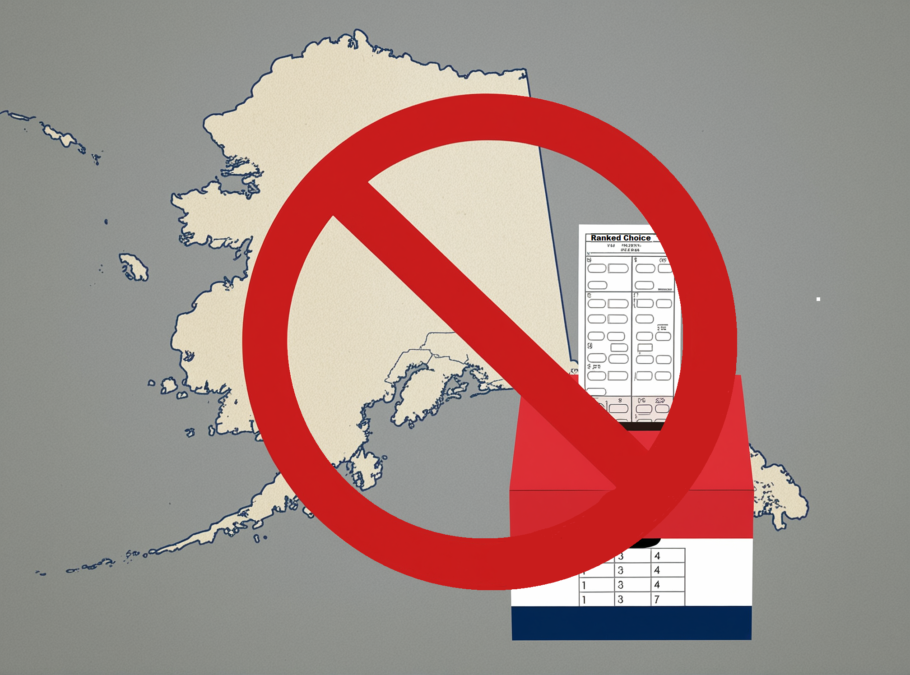
President Donald Trump brought the fight over how America counts its votes to the Last Frontier recently, telling a packed Wasilla crowd that ranked choice voting is a “scam” that has no place in a serious republic.
“Any place you have ranked choice, you have damn bad cheating,” Trump told rally-goers at an event headlined by Republican Sen. Dan Sullivan.
The president was blunt about the mechanics, too; because ranked choice voting is confusing enough that even the instruction has to be explained. A yes vote on Alaska’s Ballot Measure 2 in November repeals both ranked choice voting and the state’s “open” top-four primary system.
Trump’s visit underscored how high the stakes have gotten. Sullivan is facing a real challenge from former Democratic Rep. Mary Peltola, and control of the U.S. Senate could hinge on a state Trump carried comfortably in 2024.
But the rally also tied an immediate race to a much bigger argument, one conservatives have been making for years.
Under the current system, candidates from every party run in a single primary. The top four advance. In the general election, voters rank candidates in order of preference rather than picking one. If nobody wins a majority of first-choice votes, the last-place candidate is eliminated and those ballots get reassigned to whatever name comes next. Repeat until someone hits a majority.
Supporters call it elegant. Critics call it a parlor trick.
The measure doesn’t just touch the ballot. It also repeals campaign finance provisions bundled into the original 2020 reform, meaning Alaskans are deciding far more than whether they like ranking candidates.
Alaskans approved the system in 2020 and narrowly rejected a repeal in 2024. This year’s measure is the second bite at the apple, and it comes with a price tag: the Alaska Public Offices Commission estimates roughly $2.6 million to implement the changes and administer yet another election system.
The Heritage Foundation has called ranked choice voting “really a scheme to disconnect elections from issues and allow candidates with marginal support from voters to win elections.” Their conclusion is unsparing: “It’s all about political power, not about what is best for the American people.”
That’s the core conservative objection. RCV doesn’t just change how votes are counted. It changes who can win.
In a normal election, a ballot that follows instructions counts. In RCV, it can be thrown away. If you rank candidates who get eliminated in early rounds, and you didn’t rank anyone left standing, your vote simply vanishes. One study of Maine elections found that 60 percent of RCV victors did not win a majority of the total votes cast. Another analysis of 600,000 votes across four elections in Washington and California found the winner in all four received less than a majority of ballots.
The result, as Heritage puts it, is a “faux majority” – a majority of the remaining votes, not of the people who actually showed up.
Then there’s the turnout problem. The Foundation for Government Accountability found that RCV jurisdictions routinely post lower turnout, with odd-year elections running about 8 percent below non-RCV areas. Complexity keeps casual and first-time voters home, and low-information voters breaking late is not usually a Republican problem.
And the results are slow. Because RCV requires centralized tabulation and multiple rounds, winners frequently aren’t known on election night. FGA found 66 percent of voters are more likely to oppose RCV once they learn results can take days or weeks. In an era where every hour of ambiguity breeds conspiracy theories, that’s gasoline on the fire.
The cautionary tales write themselves:
- Maine, 2018: Republican Rep. Bruce Poliquin led after the first round, then lost after 14,076 ballots were exhausted. A Democrat won a seat the GOP had the most votes for.
- Oakland, 2010: The candidate with the most first-place votes lost after nine rounds of redistribution.
- Australia, 2010: The center-right coalition won 43 percent of first-preference votes; Labor won the House with 38 percent.
- New York City, 2021: A ranked choice mayoral primary turned into a fiasco when the elections board accidentally counted 135,000 test ballots – forcing a do-over of the public count.
Even Democrats Don’t Like It
Conservatives have a useful weapon here: RCV’s most prominent critics are Democrats.
Then-California Gov. Jerry Brown vetoed an RCV expansion in 2016, calling it “overly complicated and confusing” and saying it “deprives voters of genuinely informed choice.” Gov. Gavin Newsom vetoed a similar push in 2019, warning of “voter confusion” and that “the promise that [RCV] leads to greater democracy is not necessarily fulfilled.”
If Newsom of all people thinks your voting reform is a mess, the red flags are not window dressing.
Republicans have acted on it. Florida and Tennessee both passed sweeping bans on RCV in state and local races. The pushback is becoming a growing national posture.
Trump’s rally also shined a light on a very RCV-flavored problem: Dan Sullivan vs. Dan J. Sullivan.
A retired teacher named Dan J. Sullivan is running alongside the incumbent. Republicans accuse Democrats of propping up the second Sullivan to siphon votes from the real one. Election officials have added identifying initials to the ballot to keep it straight.
Nothing about that confusion is new to American politics. But it’s a perfect illustration of what conservatives argue: the more you complicate the ballot, the more you open the door to the wrong box getting filled.
The case against ranked choice voting isn’t that it fails to work exactly as designed. It’s that it works as designed, and the design favors whoever can game the rankings, survive the eliminations, and win a majority that never actually existed at the ballot box.
Heritage’s von Spakovsky and Adams summed it up: “So-called reformers want to change process rules so they can manipulate election outcomes to obtain power.”
Trump’s message to Alaska is simple: mark yes on Measure 2, bring back straight party primaries and one-person-one-vote general elections, and stop running an election system that requires a spreadsheet to explain.
— Political Pistachio Conservative News and Commentary